
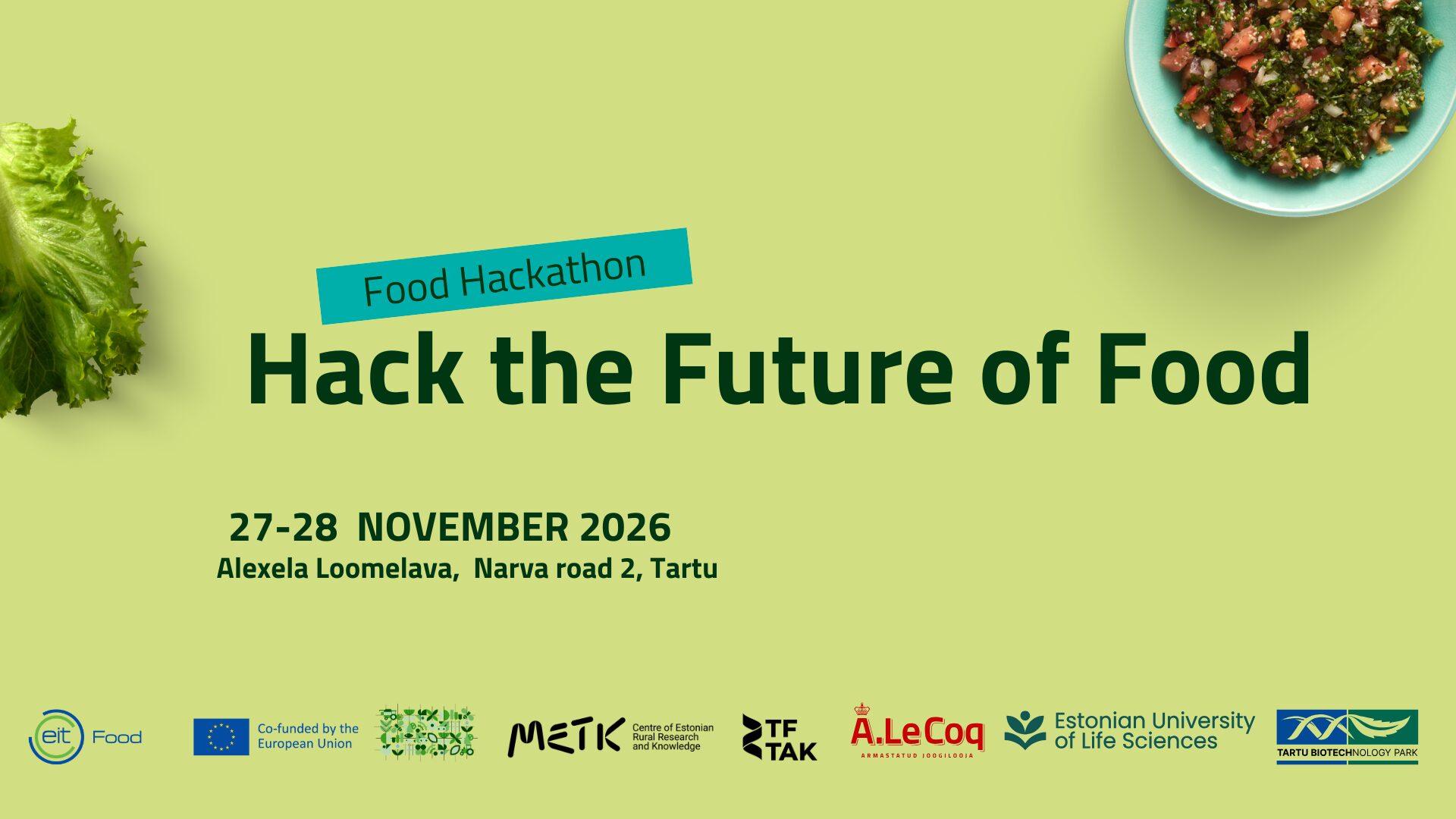
🚀 Are you passionate about food?
Join our hackathon, where we bridge the gap between science and business using design thinking methods to develop potential business solutions in the food and agriculture sectors. The hackathon aims to address real-world problems and create solutions that could be implemented in real life.
Over two exciting days, we will bring together students with entrepreneurial mindset, researchers, startups, professionals and food enthusiasts to ideate, co-create, and prototype the future of food.
Expect hands-on teamwork, mentoring from industry experts, inspirational speaker and plenty of networking opportunities.
📅 When? November 27-28, 2026
📍 Where? Alexela Loomelava, Narva road 2, Tartu
👉Register here: https://forms.gle/hqjjkKqH4Vr7fwDC7
🌱 Why join?
🎁 Tackle critical food-related challenges
🧠 Hands-on experience solving real-life problems
🎨 Design thinking and pitch training
🎤 Inspirational speaker /mentors with industry experience
🌐 Networking with like-minded people
🏆 EIT Food & partner prizes (the list is growing, stay tuned!):
- Cash prize pool of 1,500 € and an opportunity to take part in EIT Food’s business support programs
- 10 tickets to sTARTUp Day 2027 – to the first and second prize winning team
- Consultation worth 500 € from TFTAK
📅 AGENDA
Day I – 27 November
11:40-12:00 Registration
12:00–12:45 Lunch
12:45–13:00 Welcome; introduction of the hackathon schedule & activities
13:00–13:35 Introduction/Teambuilding
13:35–14:20 Idea pitches, ideation, and team formation
14:30-15:00 Coffee break
15:00–16:00 Design thinking training, Part I – Taavi Tamm / PRIA
16:00-16:05 Stretching
16:05–17:35 Design thinking training, Part II – Taavi Tamm / PRIA
17:35-18:15 Teamwork
18:15-19:00 Dinner
19:00-22:00 Teamwork
Day II – 28 November
09:00-09:30 Coffee break
09:30–09:40 Wrap-up of Day 1 and intro to Day 2, including presentation of awards and judging criteria
09:40-10:00 Inspirational speaker Mary-Liis Kütt (ÄIO) “Future-Proofing Food: How Biotechnology Can Reshape What We Eat”
10:00–12:10 Teamwork / Mentor rounds I
12:10-12:45 Pitching training – Vaido Mikheim / Startup Estonia
12:45-13:30 Lunch
13:30-15:00 Mentor rounds II /Teamwork
15:00–15:30 Coffee break
15:30–16:45 Teamwork
16:45-18:30 Pitching the ideas to the Jury + Jury feedback & prizes
18:30 Closing of the hackathon
💡You can bring your own idea or choose a challenge defined by METK, A. Le Coq, TFTAK or Estonian University of Life Sciences provided below.
Challenges from METK
1. Agricultural / food production “digital twin”
Problem: Farmers and food industries make resource-intensive decisions without the possibility to test different scenarios cheaply and quickly. As a result, too much water, energy, fertiliser or raw material is often used, and productivity and environmental impact are not optimised.
Solution: Use digital twins (AI models that simulate real agricultural practices and production processes) to test different farming and food production strategies before actual implementation begins. This helps optimise resource use and reduce environmental impact.
2. Automated monitoring and analysis systems in agriculture
Problem: Insufficient or delayed information about the condition of crops causes economic damage and, in the case of over-fertilisation and over-spraying, also environmental damage. Satellite and drone images can be used, but a recording of vegetation only shows an image; based on this alone, it is very difficult for a farmer to make fertilisation or plant protection decisions. In Estonia, the advantage of the solution to be developed would be its combination with public data.
Expected solution: Develop a solution that processes a satellite or drone image or video uploaded by the producer and converts it, based on colours, into a vegetation index (e.g. NDVI), then uses the result in a data-processing and machine-learning (AI) decision-support system.
The solution helps provide recommendations based on plant condition for different field operations, such as the amount and timing of plant protection activities and fertilisation, as well as harvest timing.
In addition, publicly available Estonian databases and applications should be used, together with the producer’s own baseline data where available (e.g. LIDAR elevation data, large-scale soil maps, the ARIB field parcel register, weather data, land-use information, the producer’s previous yield maps, etc.). The application should allow the user to download a spatial file (application map, .shp) that could be used in a fertiliser spreader or sprayer.
3. Symbiosis platform for by-products
Challenge: Every year, the Estonian food industry and agriculture generate approximately 167,000 tonnes of by-products and production residues that are not used in sufficiently value-creating applications. Companies do not know for whom their side stream might be suitable, what the quality and availability of the side stream are, or where to find the biomaterial or secondary raw material they need. This results in high waste management costs, unused business potential, a larger environmental footprint and low resource efficiency.
Solution: Create a digital platform that aggregates information on the quantities, properties and availability of by-products, enables automatic matchmaking between companies, helps find new uses for side streams in other sectors, and provides a real-time overview of available resources.
4. Decision tree for selecting crop production technology
Challenge: In regenerative agriculture, crop producers find it difficult to choose between suitable agricultural machinery and additional equipment in a rapidly developing technology landscape. It is unclear which solutions have the greatest impact and where to start. There is no overview of which solutions are currently offered by different suppliers, what their life-cycle costs are (TCO, Total Cost of Ownership), what the standards for maintenance contracts are, or how these solutions can be integrated with technologies already used by the producer.
Solution: Create a digitally managed decision-support tool (an AI-based digital solution) with step-by-step guidance for mapping needs, identifying and weighing alternatives, and making decisions.
Challenges from A.Le Coq
1. Valorisation of brewer’s spent grain
Challenge: A. Le Coq uses large volumes of malt in beer production. During the production process, brewer’s spent grain is generated with a dry matter content of 20%. Today, it is directed into the circular economy and used as part of dairy cattle feed rations. By pressing the spent grain beforehand, it is possible to obtain a nutrient-rich liquid that could have separate use value.
Solution: Analyse the properties of the liquid fraction from brewer’s spent grain and its potential uses in the circular bioeconomy for producing substances needed by the food, cosmetics and pharmaceutical industries.
2. Building a tasting panel
Challenge: A. Le Coq wants to involve a tasting panel consisting of consumers from different product groups in the development of new products and during shelf-life testing. At present, there is no structured and permanent panel and no clear solution for finding and retaining panel members or forming a representative sample. Organising tastings and collecting feedback is time-consuming and inconsistent.
Solution: Create a digitally managed tasting panel that covers the recruitment, management and segmentation of panel members according to product groups and consumer profiles. The solution enables representative samples to be formed, participants to be invited to tastings in a simple way, and feedback to be collected digitally, ensuring consistent, high-quality and comparable product evaluation.
3. Simplifying the documentation of hygiene checks
Challenge: Documenting hygiene checks in A. Le Coq’s beverage production is time-consuming and burdens employees, which affects consistency. At the same time, quality and traceability must be ensured, including in situations where visual evidence (e.g. a photo) is not available.
Solution: Create a simple and automated hygiene-check solution where documentation takes place without disrupting production, includes fixed default assessments (e.g. when no photo is available), and ensures a high-quality and traceable dataset.
4. Valorisation of high-alcohol residue
Challenge: In the production of non-alcoholic beer at A. Le Coq, a high-alcohol residue is generated as a by-product of vacuum distillation. Its handling is complex, and its potential value remains largely unused today.
Solution: Create a new product, technological solution or business model that turns this residue into a higher value-added input for food, beverage, cosmetics, cleaning or industrial applications.
Challenges from TFTAK
1. Helping small food producers launch new products with consumer evidence
Background
When a large food company like Danone or Valio launches a new product, it runs consumer taste panels, preference tests, and concept validation studies before a single product reaches the shelf. These studies tell them whether people actually like the product, what the right price point is, which packaging resonates, and what health claims are most persuasive. Small and medium food producers across Estonia and Europe — artisan cheesemakers, plant-based startups, craft fermenters — cannot afford this process. They rely on gut feeling, friends-and-family feedback, or simply put the product out and hope. As a result, many small producer innovations fail not because the product is bad, but because it was never properly tested with real target consumers before launch.
Problem
There is no accessible, affordable, and structured way for small European food producers to collect meaningful consumer feedback on new products — covering taste, packaging, price acceptance, and purchase intent — before committing to a full production run or retail listing.
Expectation
- A digital platform that allows a small food producer to design a simple consumer test (product concept, sensory preference, price sensitivity) and distribute it to relevant target consumers — without needing a research background or a large budget.
- The platform should guide the producer step-by-step through what to ask, how many responses they need, and how to interpret the results in plain language.
- Bonus: a community or marketplace element where consumers sign up to test new local food products in exchange for samples or discounts, creating a sustainable panel of engaged food testers across Europe.
2. The hidden cost of food choices: making the true price of food visible to European shoppers
Background
A chicken breast in a European supermarket might cost €3. But that price does not include the cost of the greenhouse gases emitted during production, the water consumed, the impact on biodiversity from feed crop cultivation, or the long-term health costs associated with antibiotic use in industrial poultry farming. These are called “externalities” — real costs that are paid by society and the environment but are invisible at the point of purchase. Researchers at Wageningen University and other EU institutions have developed methods to calculate these “true costs” for food products. Studies suggest that if environmental and social externalities were priced in, cheap meat would cost 2–4x more, while locally grown vegetables and legumes would become comparatively much better value. The EU Farm to Fork strategy explicitly calls for food prices to better reflect true costs, but no practical mechanism exists yet to surface this information to consumers in a shopping context.
Problem
European consumers make food purchasing decisions almost entirely on visible price, convenience, and habit — with no practical access to the environmental or social cost embedded in what they are buying. True cost research exists in academic papers but has never been translated into a usable, real-world consumer tool that is honest, non-preachy, and works in an actual shopping context.
Expectation
- A consumer tool — app, browser extension for online grocery, or shelf-label concept — that surfaces the estimated true cost of food products alongside the retail price, covering at minimum one or two environmental dimensions (e.g. carbon, water) in a way that is immediately understandable.
- A framing and design approach that presents true cost information as genuinely useful context rather than moral pressure — empowering the shopper rather than guilt-tripping them.
- Bonus: a “swap” feature that suggests an alternative product with a lower true cost at a comparable or lower retail price, showing the shopper that making a better choice does not always mean paying more.
3. Grocery receipt as a health mirror: turning what people already buy into personalised dietary feedback
Background
Every time a consumer shops at a supermarket, they generate a detailed record of their food purchases — a grocery receipt or loyalty card transaction log. This data already exists and already captures product names, quantities, frequencies, and spend. Yet this information is almost never used to give consumers any insight into their own dietary patterns. Supermarkets use it to optimise their own promotions; consumers throw the receipt away. Meanwhile, dietary recall studies — where researchers ask people what they ate — consistently show that people have poor memory of their own eating habits and tend to underreport unhealthy choices. Purchase data sidesteps this problem entirely: it is objective, longitudinal, and already collected. A growing number of Estonian and European retailers (Coop, Selver, Rimi, Maxima, Tesco, Carrefour, Albert Heijn, Lidl) have digital loyalty programmes that could in principle provide this data to consumers in a usable format — but no one has built the insight layer on top of it.
Problem
Consumers have no practical way to understand their own dietary patterns over time without manually logging food, which most people will not sustain. Their grocery purchase history — the most accurate proxy for what they actually eat — sits unused in supermarket databases. There is a significant opportunity to turn this existing data stream into personalised, actionable dietary feedback without asking consumers to change any behaviour at all in order to generate it.
Expectation
- A service or app concept that allows consumers to connect their existing supermarket loyalty account (or upload a receipt) and receive a plain-language summary of their dietary patterns over the past month — covering food group balance, variety, ultra-processed food share, and similar indicators.
- A feedback design that is based on patterns across time rather than individual meals, avoids calorie framing entirely, and focuses on simple, positive nudges: “you bought almost no legumes last month — here are three easy products to try.”
- Additional value: a privacy-respecting data aggregation model that could — with user consent — contribute anonymised population-level purchase patterns to public health researchers, creating a continuously updated picture of European dietary habits far richer than any survey.
4. Fermentation as a kitchen skill: rebuilding Europe’s lost culture of home and community fermentation
Background
For most of human history, fermentation was a household skill. Bread was leavened with sourdough starters. Vegetables were preserved by lacto-fermentation. Dairy was cultured into yoghurt, kefir, and cheese. Beer and wine were made locally. These practices preserved food, enhanced its nutritional value, supported gut microbiome diversity, and formed the backbone of food culture across every European region. Over the past 50 years, industrial food production has almost entirely displaced these practices from everyday life. The knowledge has not been formally transferred — it has simply been lost as older generations passed away and convenience food took over. Today there is a growing consumer interest in fermented foods — kombucha, kefir, kimchi, and sourdough all saw significant sales growth across the EU in the past five years. But this interest is largely passive: people buy fermented products rather than making them. The barrier is not motivation but knowledge, confidence, and the fear of doing something wrong with live microorganisms.
Problem
The practical knowledge needed to ferment food safely and successfully at home — starter cultures, temperature ranges, salt ratios, signs of healthy versus harmful fermentation, troubleshooting — is scattered across books, YouTube channels, hobbyist forums, and word of mouth. There is no structured, trustworthy, beginner-friendly digital resource that guides European consumers from zero knowledge to confident home fermenters, adapted to local food cultures and locally available ingredients.
Expectation
- A digital platform, guided learning experience, or community tool that teaches practical home fermentation to complete beginners — covering at least two or three ferment types (e.g. sourdough, lacto-fermented vegetables, kefir) with clear, science-backed safety guidance built in.
- A community layer that connects local fermenters to share starter cultures, troubleshoot batches, and exchange regional fermentation traditions — rebuilding the social infrastructure that traditionally carried this knowledge.
- Additional: a connection to the microbiome science behind fermented foods, presented accessibly — so users understand not just how to ferment but why it matters for their health, reducing fear of live cultures and increasing confidence in the process.
Challenges from Estonian University of Life Sciences
1. Tool for identifying the root causes of losses caused by product quality fluctuations
Problem: Fluctuations occurring during the production process cause product and quality losses and therefore food waste. A tool is needed to help analyse the root causes of problems, so that attention can be directed towards preventing the causes of losses. Due to time constraints or the large amount of data, these root causes may otherwise remain unidentified.
Solution: Model the production process to identify root causes and determine forecasts or focus areas by analysing production process parameters; results from raw material, semi-finished product and finished product analyses; equipment maintenance and reliability; employee training; and mapped bottlenecks in work processes. The use of AI is possible.
2. Reducing food waste when consumers throw away food labelled “use by”, although its properties would allow a “best before” date
Problem: In the Estonian food industry, many food products are labelled with “use by”, although in practice, thanks to raw material quality, technology, packaging method and a high level of hygiene, they could be “best before” products. By their nature, not all of these products pose an immediate health risk if consumed after the expiry date. For example, in Germany and Sweden, most heat-treated dairy products, meat products and fish products are “best before” products. According to the European Commission, 10% of food waste is caused by food being discarded due to date marking.
Solution: The aim is to create practical solutions that enable food industries to move safely and justifiably from “use by” labelling to “best before” labelling for products where this is justified and food safety is ensured. For example, a tool could be developed (such as a digital decision tree or risk model) that helps a company assess:
- whether the product qualifies for “best before” labelling;
- which hazards are realistic (microbiological, physical, chemical);
- which evidence-based steps are required (e.g. shelf-life testing, challenge testing).
3. AI-based optimisation of energy use in the food industry
Problem: The food industry uses large amounts of energy (electricity, steam, cooling), but energy consumption is not linked to specific production processes, batches or timing. A significant share of energy is lost as waste heat (e.g. steam, hot process streams) and is not reused.
In the Baltic region, electricity prices are high and volatile, but production planning does not take energy consumption, price signals or heat-flow integration into account. Data are often fragmented (production vs energy vs steam), which means there is no comprehensive overview of energy use and optimisation opportunities.
This leads to inefficient production, unused waste-heat potential and high energy costs, even though the goal of the hackathon is to solve real and applicable industrial problems.
Solution: Map the key areas for optimising energy use. Develop an AI-based tool that links production, energy and heat-flow data and enables energy use to be optimised at the system level. The solution should make it possible to:
- forecast energy demand by process, volume and timing;
- identify the most energy-intensive processes and sources of waste heat;
- recommend the reuse of steam and waste heat between processes;
- optimise the production schedule according to energy consumption and price;
- reduce energy consumption, costs and the CO2 footprint.
4. Valorisation opportunities for the by-product generated in oat drink production, i.e. oat okara
Problem: In recent years, the consumption of plant-based drinks has increased alongside milk consumption. Oat drink production generates a significant amount of solid by-product, oat okara, which is characterised by high moisture content (60–75%), as well as high protein and fibre content. Valorising oat okara generated in oat drink production is important both for reducing environmental burden and for promoting sustainable food production. Currently, okara is mostly sent to landfill or directed to biogas production, which creates an additional environmental burden.
Solution: Find solutions for valorising oat okara and suitable processing methods that preserve its nutritional value and improve the material’s techno-functional properties. Due to its high moisture content, microbiological safety must also be ensured during valorisation.

